What's it like being a beekeeper?

STEM career INTERVIEW with Michael Mendez
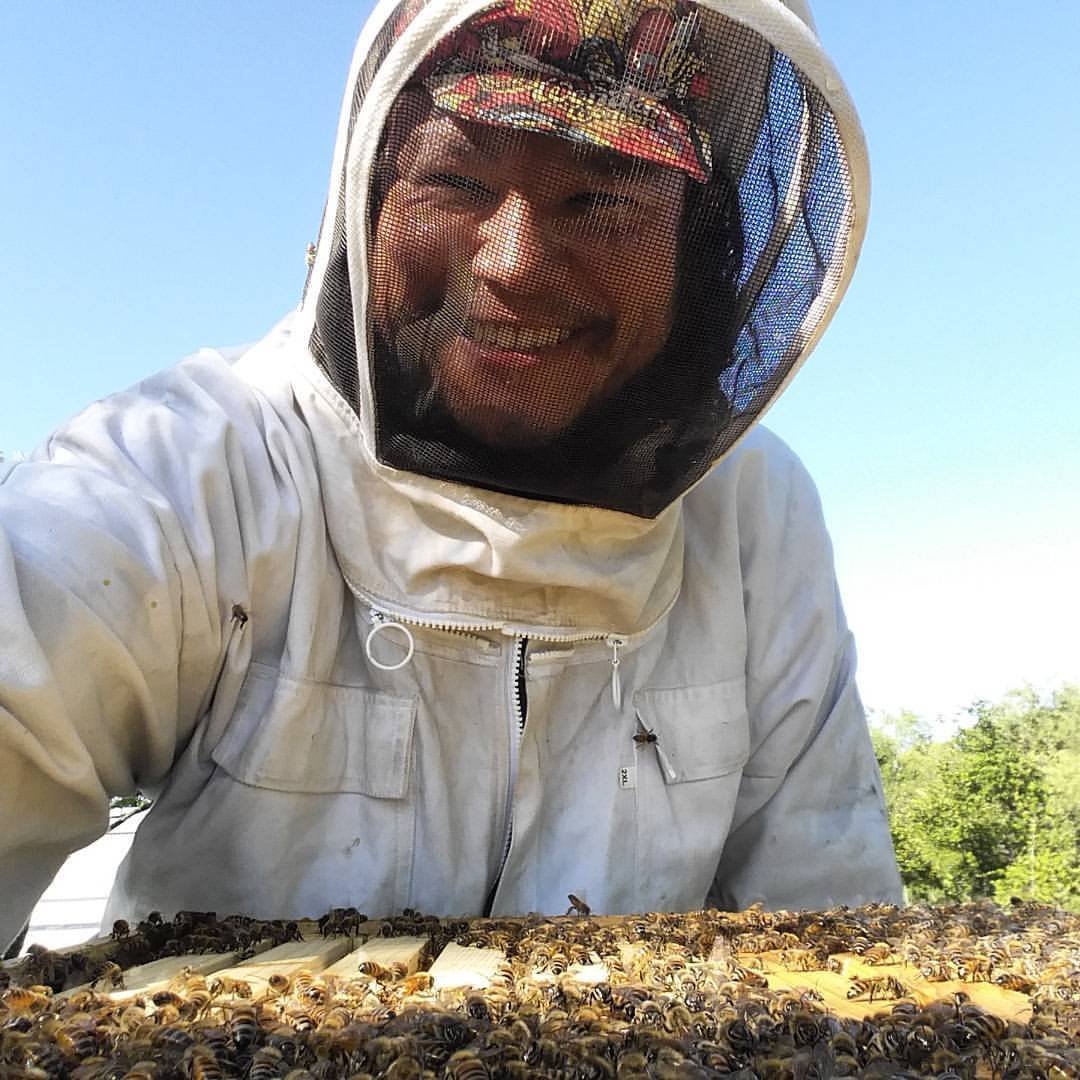
Meet Michael Mendez, Texas beekeeper. Along with his own beeyard in Creedmore, Mike manages hives for Jester King Brewery and Community First! Village, where he also teaches beekeeping. When locals need a swarm relocated or beekeeping advice, Mike is the go-to guy.    

Mike and his beekeeping gear return to the Science Mill on Saturday, April 23 for Butterfly Bonanza & Pollinator Pals—stop by to ask him your beekeeping questions!

***

How did you get started in beekeeping?

I’ve had an interest in nature since I was a kid and always loved being outdoors. Growing up in San Antonio, I got involved with the bird banding program at Mitchell Lake. By the time I was 18, I’d completed all the requirements to become a Texas Master Naturalist.

Beekeeping was right up my alley, but it still kind of happened by chance. My landlord was interested in beekeeping, and I helped him get set up. We had a master beekeeper visit one day; I learned so much watching how he handled the hive and he encouraged me to jump in. I started attending Texas Beekeeper Association meetings, reading everything I could, weeding through YouTube videos to find the best resources, and took the plunge starting my own hives. For the last decade, I’ve managed anywhere from a few to twenty hives at a time. Now I’m a step away from completing my own Texas Master Beekeeper certification.

What tools do you use as a beekeeper?

I currently keep my bees in Langstroth hives; those are the vertically stacked boxes you’ve probably seen. I’m thinking, however, about starting some top bar hives this season. They’re V-shaped, like a trough, and the bees attach their comb directly to tapered bars that hang down from the top. It’s like a single-story house where bees can travel front to back, so there’s less heavy lifting to check on the bees or harvest honey.

Protective gear is a must. You need a veil for your face and eyes and ideally a suit to cover your arms. The smoker helps keep you and the bees safe, too. There’s some debate around what smokers do. From my observations, the smoke helps block guard bees’ alarm pheromones. And if you wait a moment, the bees will start eating their nectar stores—they think it’s a fire and are preparing to evacuate. They’re focused on that job, so you can focus on yours.

There are lots of cool beekeeping gadgets. Bees use propolis (plant resin mixed with wax) to seal the hive, so you need a hive tool for unsticking and prying frames out. Queen cages are neat: they help you safely introduce a new queen while the other bees get used to her smell. I like to carry a magnifying glass, too, for getting a closer look.

Mike’s beekeeping tools in action

What skills do beekeepers need?

Observe, observe, observe! That’s true with rearing any kind of livestock: you need to spend time with the animals, get to know their behaviors, understand what their baseline looks like and see what signals a change.

Beekeepers also need a strong understanding of bee biology. The bee life cycle, from egg to adult, is my key to decoding problems; I can see where there’s a break in that cycle. I have a mental checklist when I visit a hive: I go through what’s supposed to be there and in what stage—brood, adult bees, wax, comb, nectar, pollen, honey—then compare that to what I actually see (or what’s missing) to identify issues.

One of my favorite things about beekeeping is that it’s totally in the moment. This is high-focus work. You’re looking for eggs smaller than a grain of rice or a queen who blends in with the comb, all while bees buzz around and warning pheromones burn your eyes. You need to stay calm, stay focused, and move methodically. Working with bees trains you to be a strategic thinker, so you can respond quickly in the moment—like planning ahead how you’ll reach your car keys if you encounter an aggressive hive!
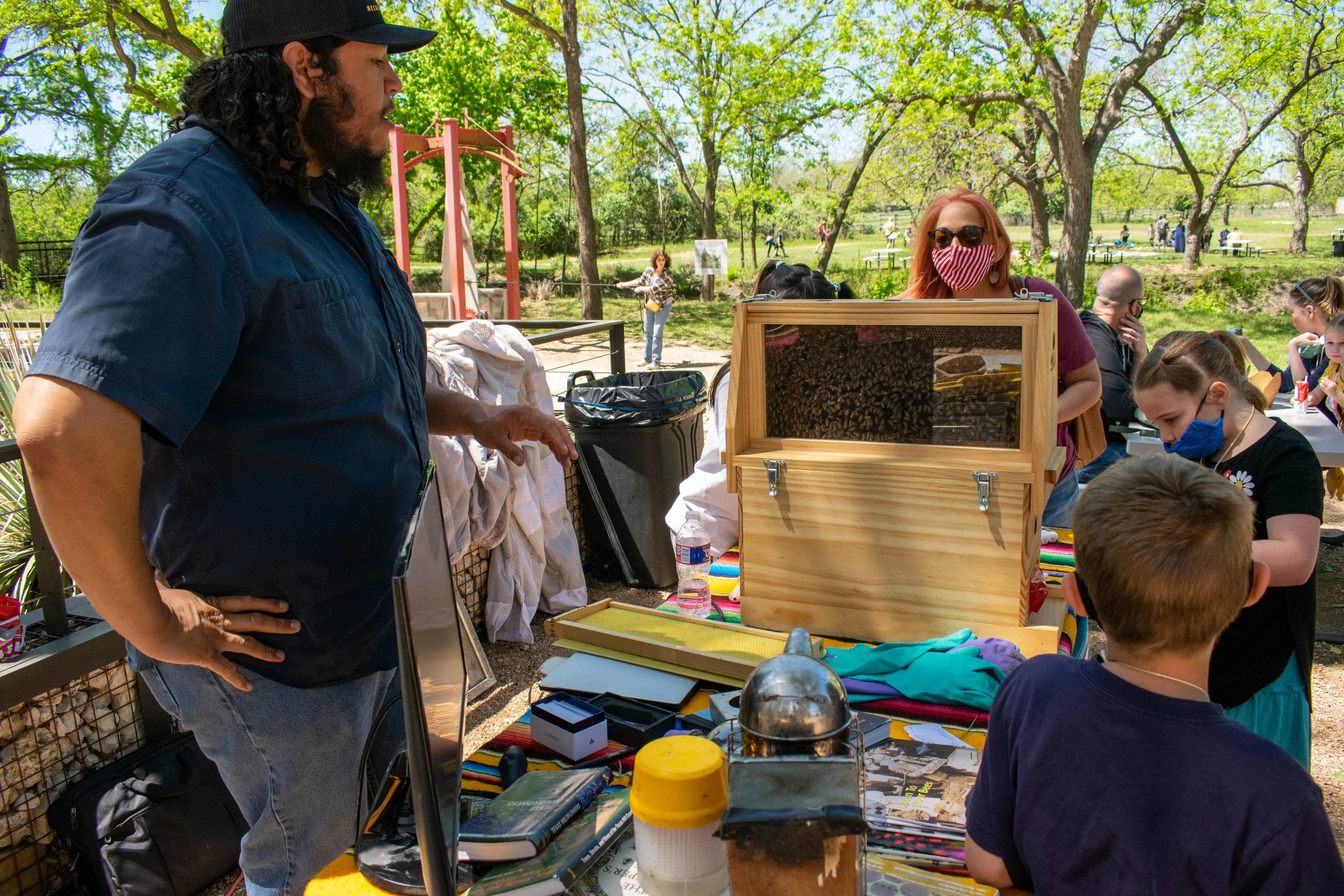
Chatting with Science Mill visitors at last year’s Butterfly Bonanza event

STEM CAREER SPOTLIGHT

So: could beekeeping be a good fit for you?

Here are some key interests and skills related to beekeeping; if these sound like you or are things you’d like to develop, beekeeping could be a good match:

  • Curious about how things grow and cycles of change

  • Enjoy working outdoors

  • Like insects and plants

  • Strong observation skills

  • Analytical thinker

  • Able to maintain focus in the moment

  • Good manual dexterity / enjoy working with your hands

You might also be interested in STEM fields similar to beekeeping, such as careers in agriculture, horticulture, animal science and natural resources. Our Explorer Zone episode on the Aquaponics Greenhouse has some good recommendations to check out. Beekeeping is also a great example of a STEM career where you build skills through on-the-job experience, rather than in a formal classroom setting. If that appeals to you, look into STEM fields that include trade schools and on-the-job apprenticeships – for example, solar electrician/solar installer.


MORE TO EXPLORE

Simple Machines Olympics

This Spring Break, the Science Mill is exploring the science behind your favorite sports with two-weeks of heart-pumping activities. Start training with this intro to the six simple machines that help our bodies, inside and out.

*** 

Two unlikely things that have a lot in common: the Olympics and the Science Mill’s Incredible Ball Machine. Sure, both are filled with thrills and spills. But behind the complex action, what they really share are simple machines.

Simple machines use energy to perform work. By harnessing the energy of motion, they make our work easier—like helping us move heavy loads or get somewhere faster with less effort.

In the Incredible Ball Machine, you’ll spot gears (wheel and axle), pulleys, slanted tracks (inclined planes), an auger (screw) and even a skateboard lever working together to keep balls in motion. (The only simple machine you won’t spot is a wedge.)

And at the Olympics? Winter or summer, you’ll see athletes team up with simple machines. Divers bouncing on boards, crews rowing with oars, and hockey players swinging sticks all put different types of levers to work. Some simple machines are obvious, like the wheels and axles that propel bike races; others are more hidden, like the pulleys used to control rigs in sailing competitions. And those snow-covered slopes that make for extreme skiing are really massive inclined planes!

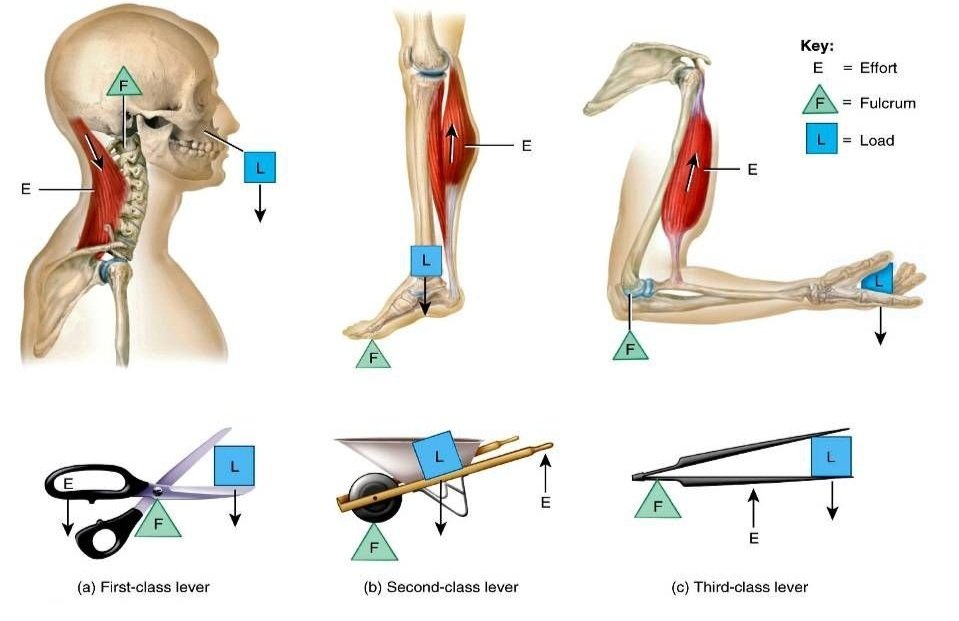
The coolest simple machines, however, are inside the athletes’ bodies—and yours. Our bones, joints and muscles act as levers, with elbows and the balls of our feet as fulcrums. Ball-and-socket joints in our shoulders and hips aren’t true wheels and axles, but serve a similar function. (Wheels don’t really occur in living things; there’s an evolutionary dilemma of how to get nutrients to a free-moving part. But scientists have discovered a weevil with screw-and-nut knee joints!) Our tendons and kneecap form a pulley system that redirects force, keeping our bones from crunching together as we lift and bend the lower leg. Our teeth are an all-star team of tiny wedges.

As complex machines, our bodies do an amazing job of coordinating these simple machines with other systems; yet sometimes things go wrong. Misdirected forces may make work less efficient or cause strain and injury. Reminders to “lift with the legs” or “stand up straight” are actually ways to keep our body machines in balance. Understanding the simple machines at work in our bodies is important not only to athletes and trainers, but to many STEM careers, including surgeons, physical therapists, rehabilitation specialists, designers of orthotics and prosthetics, ergonomic analysts, biomedical engineers, and roboticists.

Via Quora (uncredited)

TRY IT AT HOME OR SCHOOL

Compete in the Simple Machines Olympics!
Check out our Explorer Zone video on the Incredible Ball Machine for info and inspiration, then choose how you want to compete:

  • Design challenge – Come up with a Rube Goldberg-inspired contraption that uses multiple simple machines to complete a task in a wild way. Earn a perfect technical score (6/6) by incorporating an example from each of the six classes of simple machines; increase your style score with one point for every simple machine you use in total.

  • Physical challenge – Create a hexathlon (aka a six-event competition) with an event for each of the six simple machines using everyday items. For example, who can prop a door open (wedge), untwist 10 jar lids (screw), push a box up a ramp (inclined plane), or complete a lap by scooter (wheel and axle) the fastest? Who can lift the most weight with a pulley? Who has the best aim using a broom (lever) to sweep a ball into a goal?

Career Connection
“Our computer models capture and calculate different exercises, so we can see which have high force and high stress on the joints…Something that works for one person may not work for another, and that holds true for different surgical techniques, different exercises and different rehab programs.”

– Dr. Naiquan (Nigel) Zheng, Biomechanics 3-D Motion Analysis, Center for Biomedical Engineering and Science, UNC-Charlotte

MORE TO EXPLORE

Science Takes the Field – Spring Break at the Science Mill, March 7-March 18, 2022

Explorer Zone: Incredible Ball Machine (Video + activities, games, career connections)

Seeing Inside the Human Machine (Video)

Voice Over: Art Meets Engineering

National Engineers’ Week is February 20-26, 2022! Come celebrate at the Science Mill with Homeschool Day: Careers in Engineering on Thursday, Feb. 24 and Engineering Day on Saturday, Feb. 26. While you’re here, be sure to check out Voice Over, an art-meets-engineering marvel created by artist Riley Robinson. We had the pleasure of interviewing Riley about his creative process, problem solving and powering curiosity with STEAM—Science, Technology, Art and Mathematics.

***

Riley Robinson, artist and Artpace Director (Photo: Chris Castillo)

Visitors to the Science Mill have a unique opportunity to interact with a work of art and engineering by San Antonio-based artist Riley Robinson. “Voice Over started with my interest in ways we communicate,” says Riley. “I wanted to create something that had no external input”—that is, no wires, no WiFi. Voice Over features two massive steel dishes positioned on either side of the Mill’s creek. Visitors can whisper a message into one and have it heard clearly at the other, over 300 feet away, thanks to the dishes’ carefully calculated curves, which focus and direct soundwaves.

Voice Over at the Science Mill

Creating those curves was a group effort. “These days I do more work with my cell phone than with a welding torch,” Riley jokes. He connected with scientists at Southwest Research Institute, who have designed satellite dishes to transmit signals from Pluto. Based on Riley’s designs, the Southwest Research team worked out the precise calculations to make the dishes work. Riley found a metal fabricator in Minnesota to create the final pieces. “I’m a good welder,” he explains, “but these needed to be industrially produced.” While the engineers suggested aluminum for a lighter, easier build, Riley requested steel for its durability. “These pieces need to stand up to the elements for years.” Steel appears often in Riley’s outdoor works, usually with a galvanized treatment—a coating process that both protects from rust and gives his pieces a signature look. Adding this treatment to the highly calibrated dishes, however, felt too risky: “Instead, we gave them the look of galvanized steel.”

One of Riley’s other works—an enormous wrench—being galvanized; scroll down to see how it looks in the final Tool Yard installation. (Photo: Riley Robinson)

Merging practical needs with his vision for a piece is one of Riley’s favorite things about creating art for public spaces. “I love diving into the problem of each project,” says Riley. “Each site is unique and that means that some pieces might not seem to connect to what I’ve done in the past, because they’re about that particular challenge.”

For instance, compared to Voice Over or the giant-scaled tools he created for San Antonio’s City Service Center, you might not immediately recognize Riley’s hand in the thousands of colorful, dainty bluebonnets that dot the front of Bexar County’s Sky Tower at University Hospital. “That project started with an amazing body of research on how art can actually reduce the length of a patient’s hospital stay,” Riley describes. “Even down to what colors, symbols, and layouts to avoid.” Working with these guidelines led Riley to create a field of hopeful steel bluebonnets. (They’re also a nod to Julian Onderdonk, San Antonio’s “father of Texas painting,” who popularized bluebonnet scenes in the early 1900s.) “I happened to meet a transplant surgeon recently,” says Riley, “and learned that he includes Bluebonnets in his course of treatment. The medical team has patients arrive in front of the artwork as a place to chat before heading in for surgery.”

Tool Yard, Northeast Service Center, San Antonio (Photo: Riley Robinson)

Bluebonnets, Sky Tower at University Hospital, Bexar County (Photo: Mark C. Greenberg)

While Voice Over adapts well to the Science Mill’s creek, Riley originally designed it to meet the challenges of a different location: a narrow point on the Rio Grande, spanning the U.S.-Mexico border. “It will be several years and lots of paperwork before that happens, but I hope to see it there eventually,” says Riley. Until then, Science Mill visitors get to enjoy the piece on long-term loan.

In addition to his own work, Riley brings new art and artists to San Antonio as Director of Artpace, a non-profit residency program for regional, national and international artists. “There is so much problem solving that goes into bringing new works to life; it’s making connections to people in lots of different fields and learning from them to make a piece work.”

The artistic process has much in common with scientific experimentation or the engineering design process. Indeed, many educators now include Art among Science, Technology, and Math, turning “STEM” learning into “STEAM.” Riley agrees that the arts need their own spot on this important learning line-up. “Art is its own language, its own way of communicating. It allows you to see things differently and communicate differently.”

Special thanks: The Voice Over project was funded by the Rick Liberto grant for visual arts through the Artist Foundation of San Antonio.

MORE TO EXPLORE

The Science of Ice Carving

Ice is weird and wonderful. Just ask a scientist—or an artist, like Sean Leahy. Armed with a chainsaw, he’ll be carving a block of ice into a shimmering sculpture at the Science Mill’s Snow Day on Saturday, January 15, 2022.

What makes ice so weird? Unlike most compounds, water’s solid state is actually less dense than its liquid state. You see this strange trait in action when ice cubes float in a glass of water. Liquids get denser as they cool; their molecules slow and move closer together. That’s true of water, too, but only up to a point—39.2° F (4° C), to be specific. As water reaches the freezing state, the hydrogens in its H20 molecules form a hexagon-shaped network of bonds with open spaces between them. This causes water to expand in volume as it freezes and makes ice less dense. The hydrogen bonds are also the start of snowflakes’ six-sided shapes.

Molecules in liquid water (left) vs. frozen water (right), when hydrogen bonds form

As an ice sculptor, Sean has to understand those changing hydrogen bonds to predict how the ice he’s carving will behave. Start carving too soon and CRACK! An ice block can go into thermal shock when its surface warms faster than its center, causing parts to contract while others expand. Ice blocks typically need to rest for a few hours until they’ve adjusted to the surrounding air temperature. The “texture” of an ice block goes from soft to hard and back to soft as it warms. Carving also warms up the ice, so once a sculptor starts it’s a slow-motion race against temperature and time.

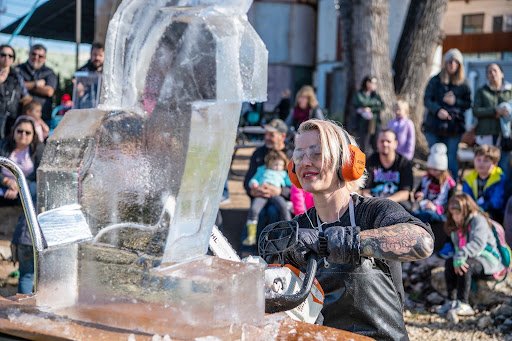
For big pieces, sculptors use chainsaws to complete about 60-70% of the carving. Then they smooth out shapes, add details and create textures with a combination of hand chisels and power tools, such as die grinders and drill bits in unique shapes. Sculptors can even weld ice blocks together to make bigger pieces (or repair a break). Depending on the temperature, they either heat the surfaces with an aluminum heating plate, carve channels for water, or add slush or dry ice to fuse the ice together.

Sculptor Griffin Ramsey uses a chainsaw to shape a block of ice at Snow Day 2020

The temporary nature of ice is what appeals to Sean as an artist. “I find satisfaction in the process of creation and appreciate the life and changes that occur as the pieces melt.”  Sean followed his childhood passion for drawing to earn a B.A. in Studio Art at Webster University. After taking a job at a local ice sculpting company, he discovered a new passion. Sean is now an award-winning Professional Carver and Ice Educator certified by the National Ice Carving Association, with his own ice sculpting company in San Marcos, TX.

See Sean in action and make your own frozen creations with 30 tons of real snow at Snow Day 2022—tickets available now (LEARN MORE)

MORE TO EXPLORE

  • Check out Sean’s latest creations for Full Spectrum Ice on Instagram

  • Using everything from hand saws to chain saws to computer-guided lasers, ice sculptor Shintaro Okamoto demonstrates techniques at 10 levels of difficulty (VIDEO)

  • A scientist and an ice sculptor explain what fascinates them about frozen water (VIDEO)

  • “Weird, hot, black ice?” Ice actually comes in over a dozen phases—some in nature, some produced in labs—including a recently created superionic ice that is modeled on planets like Neptune.

Buy Admission Tickets